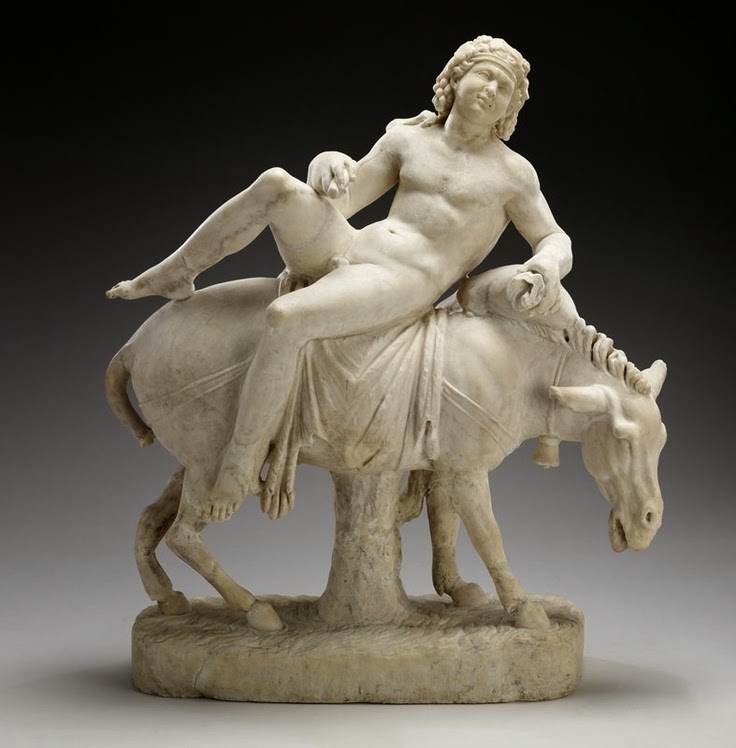
"According to the gospel story, at the height of his popularity Jesus rides into Jerusalem while crowds sing his praises and lay branches in his path. Traditionally the crowd is said to have waved palm leaves. The palm was symbolic in the Mysteries. Plato writes of 'the palm of wisdom of Dionysus’. The great festival of the Mystery godman Attis began with the 'Entry of the Reed-Bearers’, which was followed by the 'Entry of the Tree’, an evergreen pine upon which was tied an effigy of the godman. One modern scholar remarks: 'It is impossible to ignore the associations with Jesus’ entry into Jerusalem surrounded by palm-bearers, and his bearing of the cross or tree which became his chief symbol.’ The gospels relate that Jesus goes out of his way to make sure he is mounted on a donkey. In vase representations, Dionysus is also often pictured astride a donkey, which carries him to meet his passion. The playwright Aristophanes writes of 'the ass who carried the Mysteries’. When the crowd of pilgrims at Athens walked the Sacred Way to Eleusis to celebrate the Mysteries, a donkey carried a basket containing the sacred paraphernalia which would be used to create the idol of Dionysus, while the crowds shouted the praises of Dionysus and waved bundles of branches. In this way, like Jesus entering Jerusalem, Dionysus rode in triumph to his death. The mythical motif of 'riding on a donkey’ is often taken as a sign of humility. It also has a more mystical meaning, however. To the ancients the donkey typified lust, cruelty and wickedness. It symbolically represented the lower 'animal' self which must be overcome and subdued by an initiate of the Mysteries. Lucius Apuleius wrote a story called The Golden Ass, which was an allegorical tale of initiation. In it Lucius is transformed into a donkey through his own foolishness and endures many adventures which represent stages of initiation. At his final initiation he is transformed back into a human being. This story is symbolic of the initiate being overcome by his lower nature and then, through initiation into the Mysteries, rediscovering his true identity. The Egyptian goddess Isis tells Lucius that the donkey is the most hateful to her of all beasts. This is because it is sacred to the god Set, who in Egyptian mythology is the murderer of Osiris. Plutarch recorded an Egyptian festival in which donkeys were triumphantly pushed over cliffs in vengeance for Osiris' murder. Set is symbolic of the initiate's lower self, which slays the spiritual Higher Self (Osiris) and must be metaphorically put to death for the spiritual Self to be reborn. The donkey was also a common symbol of the lower 'animal' nature in the Greek Mysteries of Dionysus. A vase painting represents a ridiculous donkey with an erect phallus dancing among the disciples of Dionysus. A design on a wine pitcher shows donkeys having sex. In another design a pilgrim is shown stopping to pull the tail of a donkey. A favourite representation of afterlife sufferings in the Underworld was the figure of a man condemned to forever plait a rope which his donkey continually eats away, symbolic of the lower self constantly trying to eat away the spiritual achievements of the Higher Self. The figure of the godman riding in triumph on a donkey symbolized that he was master of his lower 'animal' nature."
-Timothy Freke, The Jesus Mysteries.
"The ass connects Christianity to Roman traditions. As Thomas Mathews states, "Early Christian art is rich with Dionysiac associations" He also points out that in "classical art the ass is common in Dionysiac processions, whether carrying Hephaistus, the divine smith, on his entry to Mt. Olympus, or Silenus, Dionysus' aged mentor... In addition, a mule, offspring of an ass and a horse, is the common transport of Dionysus himself." Thus just as visual portrayals show Jesus and Mary riding on an ass in the flight to Egypt, so Dionysus mounts an ass rather than the more noble horse, making even more interesting connections to Christianity. Images of Jesus' entry into Jerusalem while riding an ass appear on numerous Roman sarcophagi, thereby reinforcing the connection of this humble animal to Jesus."
- Laura Hobgood Oster, Holy Dogs and Assessable: Animals in the Christian Tradition.
The Last Supper...
"Ye know that after two days is the feast of the Passover, and the Son of man is betrayed to be crucified... And as they were eating, Jesus took bread, and blessed it, and brake it, and gave it to the disciples and said, Take, eat; this is my body. And he took the cup, and gave thanks, and gave it up to them saying, Drink ye all of it; for this is my blood of the New Testament, which is shed for many remission of sins. But I say unto you, I will not drink henceforth of this fruit of the vine, until that day when I drink it new with you in my father's Kingdom. And when they had sung a hymn, they went out into the mount of Olives."
- St. Matthew 26:26, King James Bible.
"The communion, the union with the divinity, plays a very great part under various forms in the later, mystically inclined religions of antiquity. In the older Greek religion it occurs in one typical and important case, the worship of Dionysos. The central rite in the orgies of Dionysos was the omophagy. In the intoxication of their ecstasy his Worshippers tore an animal to pieces and swallowed the flesh raw. The God himself was incarnated in the animal, man by virtue of the omophagy received him into his own being, was filled with his power, and was caught up from the human sphere into the divine. Here the primitive rite is transformed into a means to mystical ends, and it is because the rite provided an outlet for this tendency that the cult of Dionysos was of such great importance in the history of the Greek religion."
Martin P. Nilsson: a History of Greek Religion, page 95.
"The child of the abyss, whose blood, in this chalice to be drunk, is the pagan prototype of the wine of the sacrifice of the mass; which is transubstantiated by the words of consecration into the blood of the son of the Virgin."
- Joseph Campbell: The Masks of God: Creative Mythology, vol 4, page 23.
Water into Wine...
"And when they wanted wine, the mother of Jesus saith unto him, They have no wine. Jesus saith unto them, Fill the waterpots with water. And they filled them up to the brim. And he saith unto them, Draw out now, and bear unto the governor of the feast. And they bare it. When the ruler of the feast had tasted the water that was made wine, and knew not whence it was: (but the servants which drew the water knew;) the governor of the feast called the bridegroom, And saith unto him, Every man at the beginning doth set forth good wine; and when men have well drunk, then that which is worse: but thou hast kept the good wine until now."
- John 2:1-10, King James Bible.
"The water of Lincestis, called Acidula (sour), maketh men drunken no less than wine. Also in Paphlagonia, and in the territory of Cales. Also in the Isle of Andros there is a Temple of father Bacchus, which upon the Nodes of January always runneth with water that tasteth like wine; as Mulianus verily believeth; who was a man that had been thrice consul: the name of the spring is Dios Tecnosia."
My reviews of some of Michael Levy's Ancient Lyre albums. Check out more of his work at www.ancientlyre.com
Ancient Visions.
Michael Levy is one of the few musicians out there producing work which evokes the spirit of the ancient world. While his pieces are mainly original compositions, they are backed up with a good scholarly knowledge of how these instruments were played and remain true to the sounds of antiquity in their austere eloquence as pieces for solo lyre.
This record is inspired by the haunting sounds of Mesopotamia and makes us think of all the ancient beauty which is now sadly lost to us. That loss is made somewhat less painful by Michael's dedication to reviving the sounds of those long forgotten times.
Ode to Ancient Rome
Michael Levy's experience as an ancient lyre player has brought us this collection of wonderful tunes which do very well to take us back to classical times. He manages to recapture the feeling of Rome in all its stoical splendour. The pieces offered here give us a deep sense of tranquility which is something to be much appreciated in our modern musical era.
Michael's music is also the perfect classical reading accompaniment, so next time you pick up a book by the likes of Ovid or Homer, put this record on and let yourself be carried away by the muses.
21st Century Lyre Music
This EP is part of Michael Levy's ongoing quest to bring the musical instruments of antiquity back to us. This time however, he shows us that the lyre is not only for the tastes of the sentimentalists of the past, but should also be an instrument for our own times too. In a world with such a constantly stressful pace of life as ours, we need the calming sounds of the lyre more than ever.
Here Michael experiments with different modern sound effects which have lead him to some rather interesting results and manage to evoke a glimpse of something of vast potential proportions, all of which indicates this instrument's potential for 21st century culture. Indeed the way back is the way forward, and if our own culture can regain the harmony of classical austerity, we shall all be the richer for it. If that is not enough, It also makes for a great meditation experience!
The Lyre of Apollo
This new selection of tracks are played on a recently developed replica of an Ancient Greek lyre, which adds to the authenticity which Michael Levy strives to bring to our understanding of the ancient art of the muses. There are several of his earlier pieces presented again to us here and the difference is palpable, this new lyre has a much deeper sounding resonance. You can hear Michael's experience on the lyre in the variety of different techniques he uses and it seems that he has here reached a new level in the development of his craft.
What distinguishes his pieces is the Horatian golden mean which he manages to strike between a purely scholarly approach remaining true to original fragments together with a more openly creative artistic license taken with what the ancients mean to us today. He uses what has survived with respect but isn't afraid to fill in the gaps, as it were, to help us towards a deeper appreciation. A good example of this is stand out track "Skolion of Seikilos", one of the few pieces which have come down to us in its entirety. It has a singularly calming beauty in spite of being a song for a drinking party! So pick up a copy of Plato's symposium and this record will take you closer to it than ever.
The Lyre of Hermes
According to Greek myth, it was Hermes who invented the tortoise shell lyre and that is the premise from which Michael Levy begins his latest collection of lyre pieces. The lyre of Hermes certainly has a richer quality of sound, helping to distinguish it from the more commonly heard sound of the harp. Stand out tracks include "Lampades (Nymphs of Hades)" which demonstrates Michael's growing virtuosity along with other techniques he is developing with this new lyre. So if you want to deepen the mood whilst reading the classics, this is the perfect thing to listen to.
Argument, concerning Generation Omega of Greek Tragic Myth. From the foundation of the city of Mycenae to the post Trojan war decline of the Bronze Age.
1.
Let present day fancies tell proud story,
Days of yore fond embattled angst,
Of olden times regaled in glory,
Far-sighted Aegean heroes glanced,
Heroines enchanting beauty danced,
Feelings full of another moral age,
Against our own narrowly distanced,
High-minded decadence suffuses rage,
Undignified rantings provoke us! Turn the page!
2.
These times of plenty tempt us to squander
What the wise would so gladly put to use,
Fortune’s shadow oft’ leads minds to wander
And power’s shallow willingness abuse,
The amorous contented fit to lose
Sight of all that once felt and seemed mighty,
Overarching hierarchies fall prey, whose
Vision sees beyond local sovereignty,
Leads former truth into endless calamity.
3.
Frail uncertainty of future life,
Has no bearing on an opponents fight,
Many noble souls’ unrepenting strife,
Each attempt descends into darkest night,
Every free spirit enchained, denied sight,
Of passions, took us away from that bond,
Servitude has known not of wrong or right,
Deep embittered patience still remained fond,
For conceptual beauty! We forever longed!
4.
Then as now stumbling through an era,
Eventually to go by the name,
A classical age, Apollo’s lyre,
Or affinities holding true, the same,
Reminiscences, most have always been tame
Followers, few deserve remembrance,
Those who invent another type of game,
Set the dice rolling until decadence,
Misuse cultural riches through fat opulence!
5.
All institutions plagiarize anew,
Give ethical clarity, sense denied,
The family where sons & daughters grew,
Was founded on a stone deep red blood dyed,
Against the instincts obligingly lied,
Suit propriety, avoid provocation,
True loves passion, forgotten, pushed aside,
Deadly union, honour’s destitution,
Mutual wealth poached into cold extinction!
6.
Our world is abound with divine pretenses,
That have always sought to hold their harsh sway,
Divide unequally, raising fences,
To show who is banished and who can stay,
Invoking difference between those who’d say,
That we have no quarrel with each other, no!
Rather they would try to keep us at bay,
Final indictment their weak powers show,
Lofty in abundance! Yet spiritually low!
7.
High-minded princes, bravery’s fountain,
Not always the case we see poets told,
Men suspicious, unbelieving, doubting,
Mythology cut off in days of old,
The relevance that such tales should hold,
Over disparity of meager ways,
Not caring for eloquence unless sold,
Something fit to wile away idle days,
The genius amongst us grudgingly displays!
8.
The now ruined city of Mycenae
Was once founded by Perseus of fame,
Who rode the wingèd horse elegantly
And the snakes of Medusa’s hair did tame,
He brought low the Kraken, that very same
Threat to Andromeda, African bride,
Whose former suitor he was forced to maim,
Only the hauntiness of such Greek pride,
Could indulge romantic rivalry to be set aside.
9.
The house of Perseus soon did give way
To Atreus’ like all dynasties,
That hardly can last when led far astray,
Power always needs must feign niceties,
Lest people below test its frailties
And dare to shed the blood thought such a crime,
Only the lofty insecurities,
Who consider their problems more sublime,
And for the angst of the many? Haven’t the time!
10.
Kings can be remembered by words & deeds,
And Atreus as we know followed suit,
Devious butchery, the path to greed’s
Mad craving, the state coffers he did loot,
While holding opinion beneath his boot,
Fathered two young sons who’d even outdo
His own despicable vice, a deep root
Of wretched corruption had therein grew,
Agamemnon & Menelaus, they the two.
11.
Brothers looking to further their domains,
Marry sisters equal in chastity,
One rules Mycenae, one in Sparta reigns,
Perfect vision of royal harmony,
Set aloof to an orphic symphony,
Till marital discord of course results
In husband’s scorn! Resort to armoury,
Harsh bronze, the brutal payback for insults,
Of Paris, Helen & Aphrodite’s gentle cults.
12.
Hardly impractical Helen once back
In her place at Menelaus’ side,
Set to make up for all the former lack
Of love he’d had, his comrades who’d died
Below the walls of Troy and supplied
A metaphor of frustrated desire,
Helen ever the seductive queen lied,
And won over his hapless unquenched fire,
Weaving her way, exulting him all the higher.
13.
There is a rupture, a moment of bleak
Empty wilderness a time lost to all,
Before whence all idealists did seek,
To test their skills unprepared for the fall,
The house of old Mycenae’s blood drenched hall,
Familiar bonds not always so dear,
A king though in stature may be quite tall,
Orestes’ doom, to complacently hear,
Furies’ cry for lifeblood, his lineage clear.
14.
Tell me how could any such Delphic bard,
Make song of sparse eons’ austerity?
When even muses themselves find it hard,
The act of fine vocal dexterity?
Long gone are days of kind sincerity,
A feature so common among equals,
Fully knowing harsh pending levity,
That weight of a Bronze age that now appalls,
The pending curtain call which upon greatness falls.
15.
Orestes, son of family dispute,
To whom it fell the burden of vengeance,
Against his own kindred, to raise his boot,
Blot out the life that gave him essence,
Electra too, in his sister’s presence,
Brought down retribution on his own head,
Furies sought unremitting repentance,
They drove him forth to Athens, where it’s said,
Trial by reason! Passions soothed and put to bed!
16.
Barely come of age, the soft hairy down
Of his chin still smooth, quite easily seen,
Such youth commits matricide for the crown,
For Clytemnestra’s end he was too keen,
The hot-headed impatience of a teen,
Brought about further dynastic shift,
She having been in turn also too mean,
Orestes merely repeating to lift
The knife by which his father too was set adrift.
17.
Hardly avoidable his destiny,
Punish a mother of so little love,
For a husband long lost at war away,
Agamemnon returning felt her shove
His war weary personage from above,
Down into Hades’ waters thereabout,
Polluted bloodshed the peace of a dove,
Long since denied during Troy’s tragic rout,
Likewise, nobody cared for his own final shout.
18.
Despite his depravity, such an act,
The duty of honour should deserve praise,
To avenge a father who but lacked,
Nothing to a son which should amaze,
Agamemnon’s vengeance he obeys,
A brother & sister seem justified,
Forgetting that father’s very own craze,
Iphigenia, their sibling once sighed,
Ritual sacrifice! The Greek cause obliged!
19.
What a farce tragic theatre has but made
Epic myth set to vulgar applause,
Degrading stories, celebrities played
Any rendering true or not to laws
Of traditional dogma flouting flaws,
Contemporary adaptions, no respect
For source material. Morals & mores
Left dull and lifeless, fully inept,
Devoid of content, entertainment we accept.
20.
Greek tragedians were as bad as any,
Tinkering with myth to follow their whim,
Iphigenia found alive! Many
Plainly thought what’s the point of such a hymn?
If back from the dead, that land of the dim,
Anyone comes, fitting plots make a mess,
She turned up in Taurus or so they sing,
What enmity! For her sake, bitterness
Had bled! Generations of pointless prolonged stress!
21.
Yet to all things soon come a time of peace,
Or stagnation whatever you’d call it,
Times of imagination came to cease,
Stories of grandure no longer seemed fit,
Tales of valour, strength, iron & grit,
Gave way to a dark age with nought to tell,
Orestes’ legacy obscurely lit,
Life lived beyond its means may often knell
Decline from the heights into ignorance and hell.
22.
Helen, let’s not forget, had a daughter,
By Menelaus before having fled,
Hermione for many a winter,
While her parents’ quarrel at Troy bled,
Waited. Euripides’ passion has said,
That the girl grew refined yet lecherous,
Neoptolemus fought for her soft bed,
Against Orestes for the dangerous
Bride. Fitting prize for the cunningly murderous!
23.
Neoptolemus, that son to surpass
Exploits of his father Lord of the dead,
Swift footed Achilles, yes, he the mass
Murderer who to hungry hounds had fed,
Priam’s son Hector, the one who had led,
Troy’s only hope, defiance resistant,
The son won Andromache who still shed
Tears for fine Hector, her husband distant,
Indulging Neoptolemus not an instant.
24.
He was such a match for his father plus,
The same instinct for ruthless savagery,
He also goes by the name of Pyrrhus,
Shorter an appellation, you’ll agree,
Than Neoptolemus, I’m sure you’ll see,
It’s intolerable to use again,
Too many syllables! Bad poetry!
Half a line gone, if you count up to ten,
A scribe has got to limit the use of his pen.
25.
Well Hermione like I was saying
Wasn’t too pleased by the sordid idea,
Of a rival, Pyrrhus’ heart straying,
She was quite happy to stand by and cheer,
As Pyrrhus fought Orestes, we now hear,
For her own love! Yes, those men can sweat!
But against a slave, Andromache dear,
She saw nothing more than a foreign threat,
Compassion for the vanquished unlearnt as of yet.
26.
All this envy though soon came to nothing,
It’s often the case in confusing myths,
Grandiloquence we find somehow soothing,
Just as we gossip over lovers’ tiffs,
So, what happened next? There are many ifs,
Ancient sources are always vague and sparse,
History is full of bores squares & stiffs,
Repeating, reliving the same old farce,
At least here you’ve got the plain original dance!
27.
There’s one thing of which we can be sure,
Pyrrhus made his way to the Delphic shrine,
Above Mount Parnassus, below azure
Skies of central Greece, now in sad decline,
But then in its heyday, high in its prime,
There by Apollo’s columns of marble,
Doric in stature and encased in lime,
The stones by which Orestes would gamble,
Hermione’s hand in open bloody battle.
28.
Here wanton poets really meet their test,
Gore soaked stanzas, not for the faint-hearted!
Yet tragedy puts action off stage, lest
Crowds listened as eloquence departed,
Maybe that’s why I just can’t get started,
On unavoidable confrontation,
The clash of Bronze, tell me! Who’ll be martyred?
Warriors without ill hesitation,
Lovers of these fine arts would show indignation.
29.
Off with Hermione, his promised wife,
Hardly worth repeating, Orestes won,
Pyrrhus, like father, threw away his life,
He’d fought desperately, yet all he’d done,
Was upset Apollo, spoil his fun,
Who’d favoured Orestes long since the days,
When he’d begged sanctuary on the run
For murdering his mother in a craze,
Thus the archer god shows benignity, Homer says.
30.
After his ordeals Orestes went
Back to his homeland pacified and won,
Ruled over his people, a landed gent,
Accepting his mastery he’d begun
To rule by decree and to blindly shun,
The needs of a people little heeded,
He hired politicians who then spun,
Any old mantra that kept motives hid,
Ignoring what poverty and hunger pleaded.
31.
In little time the whole Peloponnese
Was united, bowing down at his feet,
Mycenae flourished in a time of ease,
Agamemnon’s son did grander a feat,
Than in those old times of his father’s seat,
All wasted on foreign intervention
Wars were won, but bringing homebound defeat,
People neglected of education,
Invest not in the future but segregation.
32.
Rebellious streak fiercely indignant,
The Greeks have had since those forgotten days,
Filled their streets with oratory and chant,
They forgive little of abusive ways,
A spirit hardly willing, never pays
To passively look on as the corrupt,
Try their tricks, saying it’s only a phase,
Squeeze the economy! Ruin, disrupt,
Our swindled hopes brought to an end abrupt!
33.
Untolerated a tyrant returns
In yet another form more sleekly clad,
With ways to pilfer what the worker earns,
Always devious, malicious and glad,
Rejoicing to take away all we had,
While daring to say it’s his divine right,
Only common people recognise bad,
But never cease to dream! What’s far from sight?
Never lower their heads nor wallow in their plight!